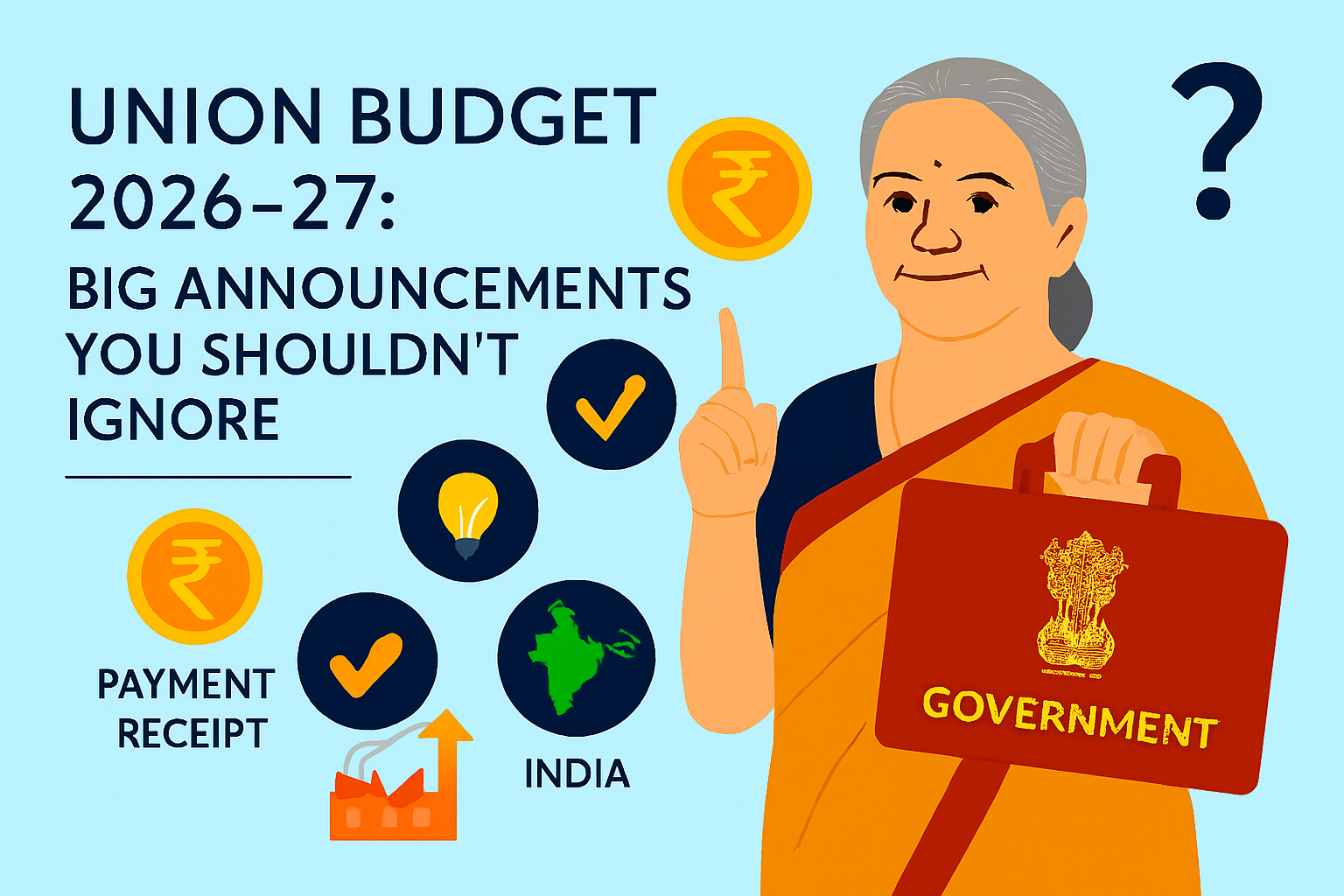
The Union Budget 2026–27 outlines the Government of India’s fiscal strategy for sustaining economic growth, strengthening infrastructure, managing deficits, and ensuring balanced federal transfers. Presented at a time of global economic uncertainty, the budget reflects a calibrated approach to capital-led growth, fiscal consolidation, and state support.
This blog provides a detailed breakdown and interpretation of the key budgetary numbers, transfers, borrowings, and fiscal indicators as highlighted in the official data.
1. Overview of Union Budget 2026–27
The Union Budget serves three core purposes:
- Allocation of government expenditure
- Mobilisation of revenue
- Management of fiscal deficit and public debt
For FY 2026–27, the government has focused on:
- Higher infrastructure investment
- Controlled fiscal deficit
- Strengthening state finances
Improving the quality of expenditure
2. Key Budget Aggregates for FY 2026–27
Documents help the government:
✔ identify business owners
✔ understand business activities
✔ prevent fraud
✔ ensure legal compliance
Simple Example:
Just like a school asks for a child’s ID and address proof, the UAE asks for basic business documents.
Total Expenditure – ₹53.47 Lakh Crore
The total expenditure represents the overall spending commitment of the central government for FY 2026–27.
This includes:
- Revenue expenditure (salaries, subsidies, interest payments)
- Capital expenditure (infrastructure and asset creation)
The scale of expenditure reflects the government’s intent to support economic growth while maintaining fiscal discipline.
Capital Expenditure (Capex) – ₹12.21 Lakh Crore
Capital expenditure remains a central pillar of the budget.
Capex is directed towards:
- Transport infrastructure
- Railways and logistics
- Urban development
- Energy and digital infrastructure
Higher capex has a multiplier effect, stimulating private investment, employment, and long-term productivity.
Effective Capital Expenditure – ₹17.14 Lakh Crore
Effective capital expenditure includes:
- Direct central government capex
- Capital grants and loans to states for infrastructure
This expanded measure highlights the true public investment push, indicating strong government commitment to asset creation across both central and state levels.
3. Revenue Profile of the Government
Revenue Receipts – ₹35.33 Lakh Crore
Revenue receipts comprise:
- Tax revenue
- Non-tax revenue
These receipts fund day-to-day government operations and welfare schemes.
Gross Tax Revenue – ₹44.04 Lakh Crore
Gross tax revenue includes collections from:
- Income tax
- Corporate tax
- Goods and Services Tax (GST)
- Customs and excise duties
Strong tax collections indicate:
- Stable economic activity
- Improved compliance
- Efficient tax administration
Net Tax Revenue to Centre – ₹28.67 Lakh Crore
After devolving states’ share of taxes, the net tax revenue available to the central government stands at ₹28.67 lakh crore.
These funds are central schemes, defence, infrastructure, and debt servicing.
Non-Tax Revenue – ₹6.66 Lakh Crore
Non-tax revenue includes:
- Dividends from public sector enterprises
- Interest receipts
- Fees and penalties
Diversification of revenue sources helps reduce excessive reliance on taxation.
4. Transfers and Borrowings
Total Transfers to States and Union Territories – ₹26.21 Lakh Crore
Transfers to states are a crucial feature of India’s federal fiscal structure.
These transfers support:
- State infrastructure projects
- Social sector spending
- Regional development initiatives
States’ Share of Taxes – ₹15.26 Lakh Crore
This represents the constitutional devolution of taxes to states, enabling them to meet their expenditure responsibilities independently.
Market Borrowings (Government Securities) – ₹11.73 Lakh Crore
Market borrowings are used to finance the fiscal deficit.
Borrowing through government securities ensures:
- Transparency
- Market-based interest rates
- Long-term debt sustainability
Total Borrowings and Liabilities – ₹16.96 Lakh Crore
This includes:
- Fresh borrowings
- Roll-over of existing liabilities
The government has aimed to balance borrowing needs with fiscal prudence.
5. Fiscal Indicators: Assessing Fiscal Health
Fiscal Deficit – ₹16.96 Lakh Crore (4.3% of GDP)
The fiscal deficit measures the gap between total expenditure and total receipts (excluding borrowings).
A deficit of 4.3% of GDP indicates:
- Gradual fiscal consolidation
- Alignment with medium-term fiscal targets
Revenue Deficit – ₹5.92 Lakh Crore (1.5% of GDP)
Revenue deficit arises when revenue expenditure exceeds revenue receipts.
A declining revenue deficit suggests:
- Better quality of expenditure
- Reduced reliance on borrowing for consumption
Effective Revenue Deficit – ₹0.99 Lakh Crore
The low effective revenue deficit indicates that a significant portion of borrowing is being directed towards capital asset creation, rather than routine expenditure.
Primary Deficit – ₹2.92 Lakh Crore
Primary deficit excludes interest payments and reflects current fiscal effort.
A contained primary deficit demonstrates:
- Improved fiscal management
- Reduced debt stress
6. Key Takeaways from Union Budget 2026–27
- Strong emphasis on capital expenditure-led growth
- Continued support to states through higher transfers
- Improved quality of fiscal deficit
- Controlled borrowing strategy
- Focus on long-term economic sustainability
7. What This Budget Means for Businesses and Citizens
For businesses:
- Improved infrastructure
- Better logistics and connectivity
- Stable macroeconomic environment
For citizens:
- Enhanced public services
- Employment generation through capex
- Long-term economic stability
Conclusion
The Union Budget 2026–27 reflects a balanced fiscal approach—prioritising growth through infrastructure investment while maintaining fiscal discipline. By improving the quality of expenditure and managing deficits prudently, the government aims to support sustainable economic expansion.
For policymakers, businesses, and citizens alike, the budget signals continuity, stability, and forward-looking economic planning.